The First Call Rule: Why 80% of Customers Will Not Leave a Voicemail
There is a rule in service business sales that most owners learn the hard way.
You get one shot at a new customer. Not two. Not a callback window. One.
The moment an inbound call goes unanswered, the probability of converting that caller to a paying customer drops by more than 80%. Not because they are impatient. Not because they are unreasonable. Because they have three more results on Google and zero reason to wait for you.
This is what we call the First Call Rule. And understanding it changes how you think about every phone that rings in your business.
Where the 80% number comes from
The research on caller behavior in service industries is remarkably consistent across multiple sources.
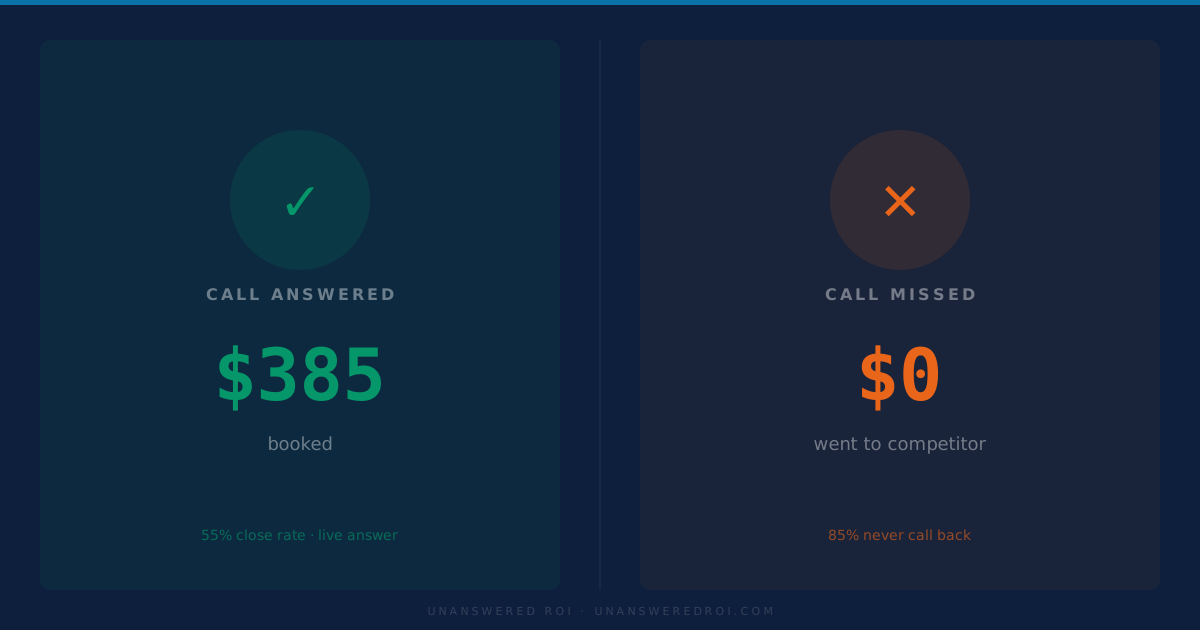
Invoca's call intelligence data, pulled from more than 100 million tracked calls across home services, healthcare, and legal verticals, shows that 85% of callers who do not reach a live person on the first attempt do not call back. They move on within minutes, usually to the next result in Google's local pack.
A separate study from Hatch tracking inbound leads across 1,200 home services businesses found that the contact rate for missed calls drops by 80% within the first 5 minutes. If you call back a missed caller within 5 minutes, you have a reasonable shot. After that, your odds collapse.
Harvard Business Review's analysis of lead response time across B2C service businesses found that companies that contacted leads within an hour were 7 times more likely to convert than those who waited longer. For service businesses where the customer need is urgent, a broken AC, a burst pipe, a dental emergency, that window is even shorter.
The pattern is the same across every source: the first call is almost always the only call. Miss it and the customer is gone.
Why customers do not leave voicemails
The assumption built into most service business phone strategies is that voicemail is a safety net. Someone calls, gets voicemail, leaves a message, and you call them back.
The data does not support this assumption.
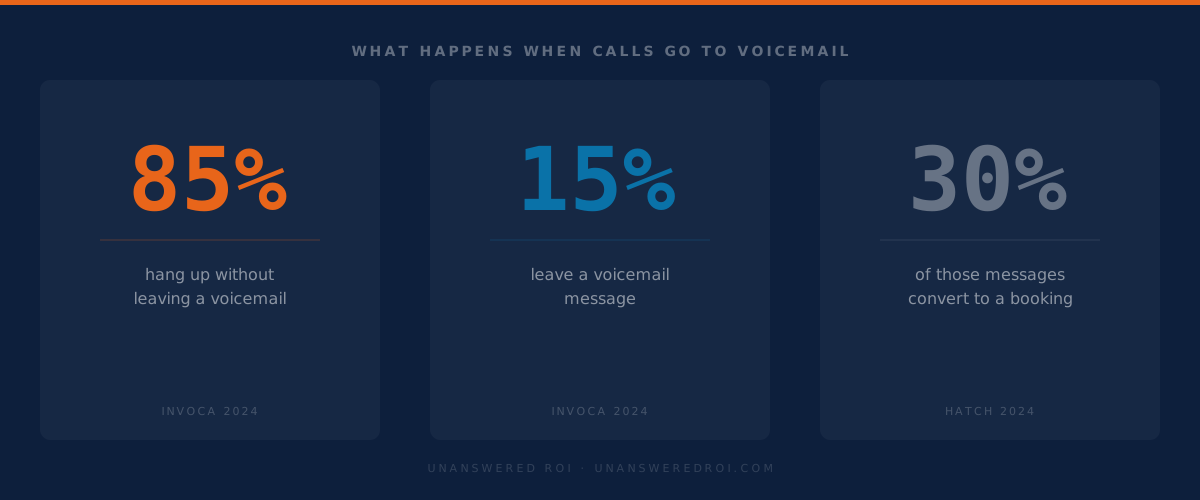
Across home services verticals, fewer than 15% of callers leave a voicemail when they reach one, according to Invoca's call tracking data. The remaining 85% hang up and move on.
There are three reasons for this.
Voicemail feels like a dead end. When a consumer calls a service business with an urgent problem, they are not in a "leave a message and wait" mindset. They need a solution today. A voicemail greeting signals that the business is unavailable, not temporarily, but right now when they need help. The instinct is to find someone who is available.
Competition is one tap away. Google's local pack shows three to five competitors in every service vertical. The friction of finding an alternative is essentially zero. There is no switching cost, no relationship to protect, no reason to wait. The next option is already on their screen.
Consumers have been trained not to trust voicemail. A significant portion of service business voicemails never get returned, or get returned too late, after the customer has already booked with someone else. Callers know this from experience. Leaving a voicemail feels like a low-probability action, so most do not bother.
The voicemail conversion trap
Here is where it gets counterintuitive.
Of the 15% of callers who do leave a voicemail, fewer than 30% convert to a booked job, even when the business calls back promptly. Compare that to a 55% close rate for live-answered calls across home services verticals.
So voicemail does not just capture fewer leads. It converts them at roughly half the rate of live-answered calls.
The reason is intent decay. When a customer calls with an urgent problem, their intent to book is at its peak. Every minute that passes without resolution reduces that intent. By the time you call them back, even if it is within an hour, they have often already booked with a competitor, resolved the issue another way, or simply moved on mentally.
The live-answered call catches the customer at peak intent. The callback catches them after intent has decayed. The conversion gap, 55% versus 30%, is a direct measurement of that decay.
For a plumbing business taking 200 calls per month at a 25% miss rate, this matters enormously:
- 50 missed calls per month
- 8 leave a voicemail (15%)
- 2 to 3 convert at the voicemail rate (30%)
- 47 to 48 are permanently lost
Voicemail is not capturing your missed leads. It is giving you the illusion that you are.
The industries where the First Call Rule hits hardest
The First Call Rule applies across all service verticals, but it hits hardest in businesses where the customer need is urgent and alternatives are plentiful.
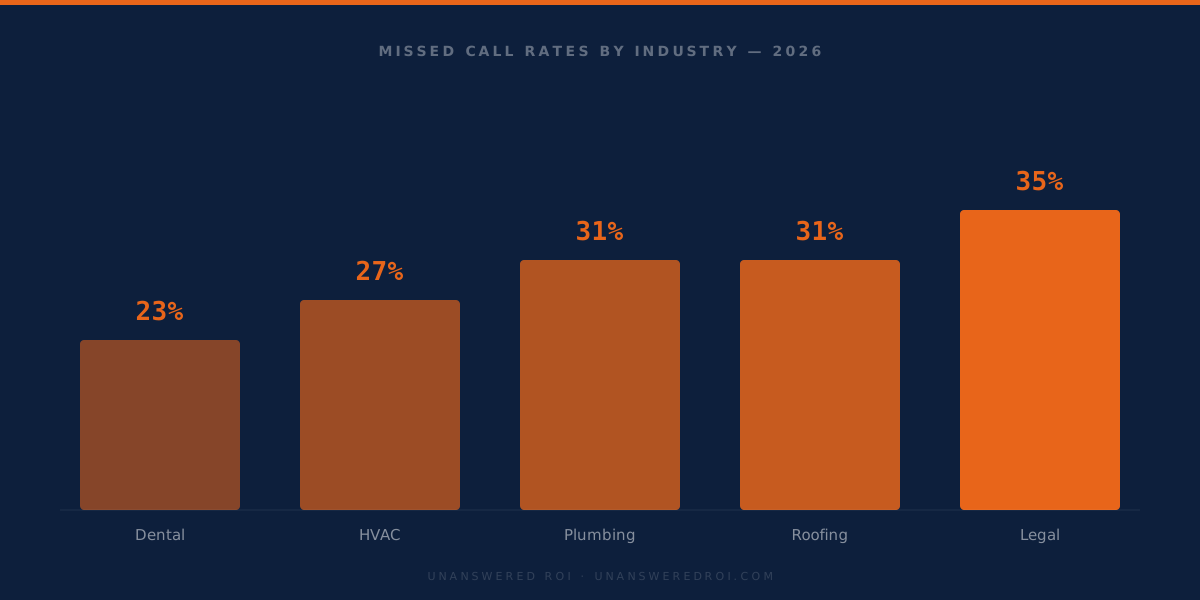
HVAC is the most acute case. A homeowner calling about a no-cool situation in July needs help today. They are not going to wait 48 hours for a callback. If you do not answer, your competitor does. HVAC businesses miss 27% of inbound calls on average, and during peak season that number climbs to 32% or higher. The revenue impact for a 6-truck HVAC operation runs to $109,000 per year.
Plumbing is similar. A burst pipe or a backed-up sewer line is not a "leave a message" situation. Plumbing businesses miss 31% of inbound calls on average, according to Housecall Pro's benchmark data.
Legal intake is the most expensive vertical by dollar value. Personal injury, family law, and criminal defense firms miss up to 35% of inbound calls. At an average case value of $3,800 to $12,000, a single missed intake call can represent tens of thousands in lost revenue over the life of the case.
Dental and medical practices face a different version of the problem. New patient calls are the most valuable calls a practice receives. A new dental patient has a lifetime value of $8,000 to $12,000. Dental practices miss 23% of inbound calls on average, with the front desk as the primary bottleneck.
In every case, the math is the same. The first call is the only call. Miss it and you miss the customer.
What the First Call Rule means for your staffing model
Most service businesses staff their phones for average call volume. One CSR, standard business hours, voicemail after hours.
This model works when calls arrive in a smooth, predictable stream. It fails in three situations that are completely predictable:
During surges. Inbound calls do not arrive evenly. They cluster, Monday morning after a weekend breakdown, Tuesday after a storm, the hour after your Google ad runs. When three calls come in simultaneously and one person is on the phone, someone waits. When the wait exceeds 90 seconds, most callers hang up.
During peak season. As covered above, peak season doubles or triples call volume for the same headcount. The miss rate climbs. The revenue impact multiplies.
After hours. The assumption is that after-hours calls are low value. The data says otherwise. Invoca's analysis of home services call timing shows that 34% of inbound HVAC calls arrive outside standard business hours, evenings and weekends when homeowners are home and noticing problems. These calls go to voicemail or a recorded message. Virtually none convert.
Staffing for average is a rational response to a financial constraint. It is also a structural guarantee that you will miss a significant percentage of your highest-value calls.
The lifetime value multiplier
Everything above understates the real cost of the First Call Rule because it only counts the first job.
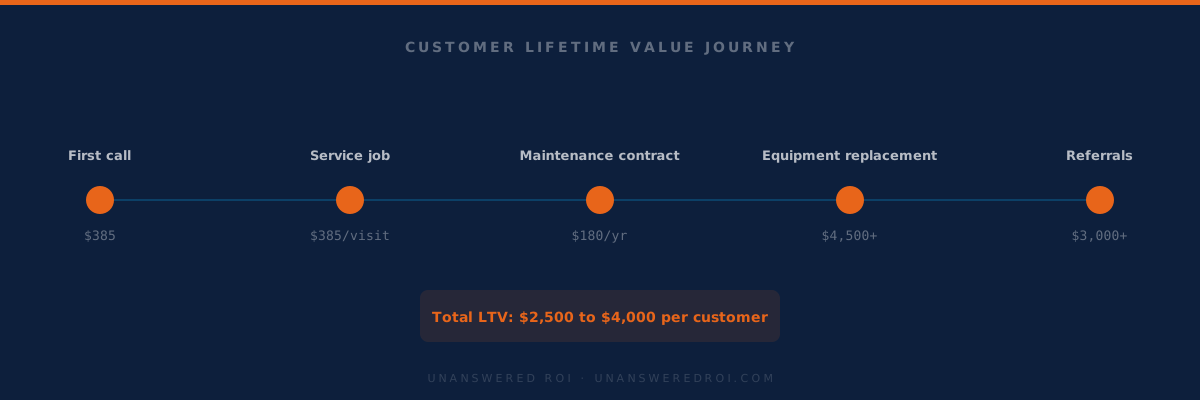
Service businesses with strong customer relationships have significant lifetime value. An HVAC customer who books a service call has a meaningful probability of becoming a maintenance contract customer, an equipment replacement customer five to ten years down the road, and a referral source for neighbors and family members.
ServiceTitan's customer lifetime value analysis puts the average HVAC customer lifetime value at $2,500 to $4,000 depending on the market and the business's service mix. A dental patient is worth $8,000 to $12,000 over the course of the relationship. A personal injury legal client, if the case is won, can represent $15,000 to $50,000 in contingency fees.
When you miss the first call, you are not losing one job. You are losing all of that.
For a 6-truck HVAC operation missing 81 calls per month, and assuming each converted customer has a lifetime value of $3,000:
- 81 missed calls per month
- 85% do not return = 69 permanently lost
- At a 55% conversion rate if answered = 38 customers permanently lost per month
- 38 customers x $3,000 lifetime value = $114,000 in lifetime value lost per month
That number is not actionable in the same way the monthly revenue loss is. You cannot book $114,000 in lifetime value next month. But it clarifies what is actually at stake when the phone rings and nobody answers.
What answering every call actually costs
The counterargument to all of this is cost. Answering every call is expensive. A second CSR costs $35,000 to $45,000 per year in salary and benefits. An answering service runs $200 to $500 per month. An AI receptionist runs $200 to $600 per month.
These are real costs. They should be weighed against the revenue math.
For a 6-truck HVAC operation losing $9,100 per month to missed calls, the break-even on a $400 per month solution is straightforward:
$400 solution that recovers 30% of missed calls:
- 30% of 81 missed calls = 24 additional answered calls
- 24 x 55% close rate = 13 additional booked jobs
- 13 x $385 = $5,005 in additional monthly revenue
- Net gain after solution cost: $4,605 per month
The solution pays for itself in the first three days of the month. The remaining 27 days are margin recovery.
The First Call Rule is not an argument for spending money you do not have. It is an argument for understanding the cost of the status quo before deciding it is acceptable.
Finding your number
Every business is different. Your miss rate, call volume, and average job value determine your specific exposure.
The Unanswered ROI calculator uses verified industry benchmarks for your specific vertical, miss rate, close rate, and average job value, to calculate your monthly revenue loss, recovery potential, and 5-year exposure.
It takes 30 seconds. The number it gives you might change how you think about your phones.
Calculate what your missed calls are costing you
Related reading:
Statistics sourced from Invoca Call Intelligence Report 2024, Hatch Home Services Benchmark Report 2024, ServiceTitan HVAC Benchmark Report 2024, and Housecall Pro State of Home Services 2024. Harvard Business Review lead response time analysis referenced for contact rate decay data. Full methodology available at unansweredroi.com/sources.